
Best Hidden Fasteners for Ipe Decking: Clip Comparison Guide
Grooved Ipe decking and other hardwoods are extremely popular for concealed fastening. When it comes to Ipe decking and other Brazilian hardwoods, the fastening system you choose matters just as much as the wood itself.
Hidden fasteners—commonly called deck clips—have become the preferred way to create a clean, screw-free surface. But not all clip systems are built the same.
Many systems on the market were originally designed for composite or softwood decking, not dense hardwoods like Ipe or Cumaru. That difference shows up in real-world performance, especially in areas like board movement, hold-down strength, and long-term serviceability.
This guide breaks down the most common hidden fastening systems used in hardwood decking today. Below, you’ll find a side-by-side comparison chart followed by a breakdown of what each category means—and why it matters.

What Really Matters When it Comes to Hidden Clips for Hardwood Decking?
Not all hidden fasteners are evaluated the same way—and most comparisons miss the details that matter most for hardwood decking. Below are the key categories used in this comparison, along with why each one matters in real-world installations.
- Material — The strength and durability of the clip itself. Hardwood decking creates significantly more stress on fasteners than composite. Materials like coated aluminum or stainless steel tend to perform better than plastic-based systems over time.
- Clip Bearing Width — The amount of surface area holding the board down. A wider bearing surface helps distribute load, reduce movement, and improve long-term stability—especially important with dense hardwoods.
- Butt Joint Solution — How the system handles two boards meeting on a single joist. This is one of the most common failure points in decking. A proper solution helps prevent movement, lifting, and visible gaps over time.
- Pre-Drilling Required — Whether the system requires pre-drilling before fastening. Systems that eliminate this step can significantly speed up installation and reduce labor costs.
- Fastener Access After Installation — Whether you can access the fastener after boards are installed. This becomes critical if you ever need to replace a board or make adjustments later.
- Starter System — Whether the system includes a clean and effective way to start the first row of boards. Some systems require improvised solutions, which can slow down installation.
- Adhesive Compatibility — Whether the system allows or recommends adhesive. Adhesive can improve hold-down strength and reduce long-term movement when used correctly.
- Board Spacing — The gap created between boards. Proper spacing is critical for drainage, airflow, and expansion—especially with hardwood decking.
- Perimeter & Trim Fastening — How the system handles edges and face fastening. Many systems require separate solutions, while others integrate better with plug systems like the Pro Plug System.
- Designed For — Whether the clip is built specifically for hardwood or designed as a universal system. Hardwood-specific systems tend to perform better under real-world conditions.
Now, let’s look at how the major clip systems compare side-by-side.
| Category | BWD Deck Clips Hardwood-specific system | Ipe Clip Extreme Standard / S variation | CAMO Edge Clip Universal decking category | Simpson EB-TY Model EB316W | Tiger Claw TC-120 With TC-150 for butt joints | Black Talon Universal Spring tension style clip |
|---|---|---|---|---|---|---|
| Material | Aluminum clip (599 Magna-coated) with 2.5″ Magna-coated screws; stainless screw upgrade available for marine environments | Plastic clip with stainless steel reinforcement | Plastic clip with stainless steel gusset | Polypropylene clip with stainless steel reinforcement | Folded stainless steel clip | Folded stainless steel clip with thin spring-tension profile |
| Board Spacing Created | 1/8″ | 3/32″ (standard) / 5/32″ (S) | 3/16″ | 3/16″ | Not specified (appears ~1/8″ to 3/16″) | >3/16″ |
| Pre-Drilling Required | No | Yes | No | Yes | No | No |
| Fastener Access After Installation | Yes — remains accessible after board installation | No — fastener head is not accessible | Yes — fastener remains accessible | No — fastener head is not accessible | No — fastener head is not accessible | Yes — fastener remains accessible |
| Adhesive Compatibility | Yes — recommended for optimal performance | Not addressed as part of the recommended process | Not addressed as part of the recommended process | Yes — included as part of the recommended process | Not addressed as part of the recommended process | Not addressed as part of the recommended process |
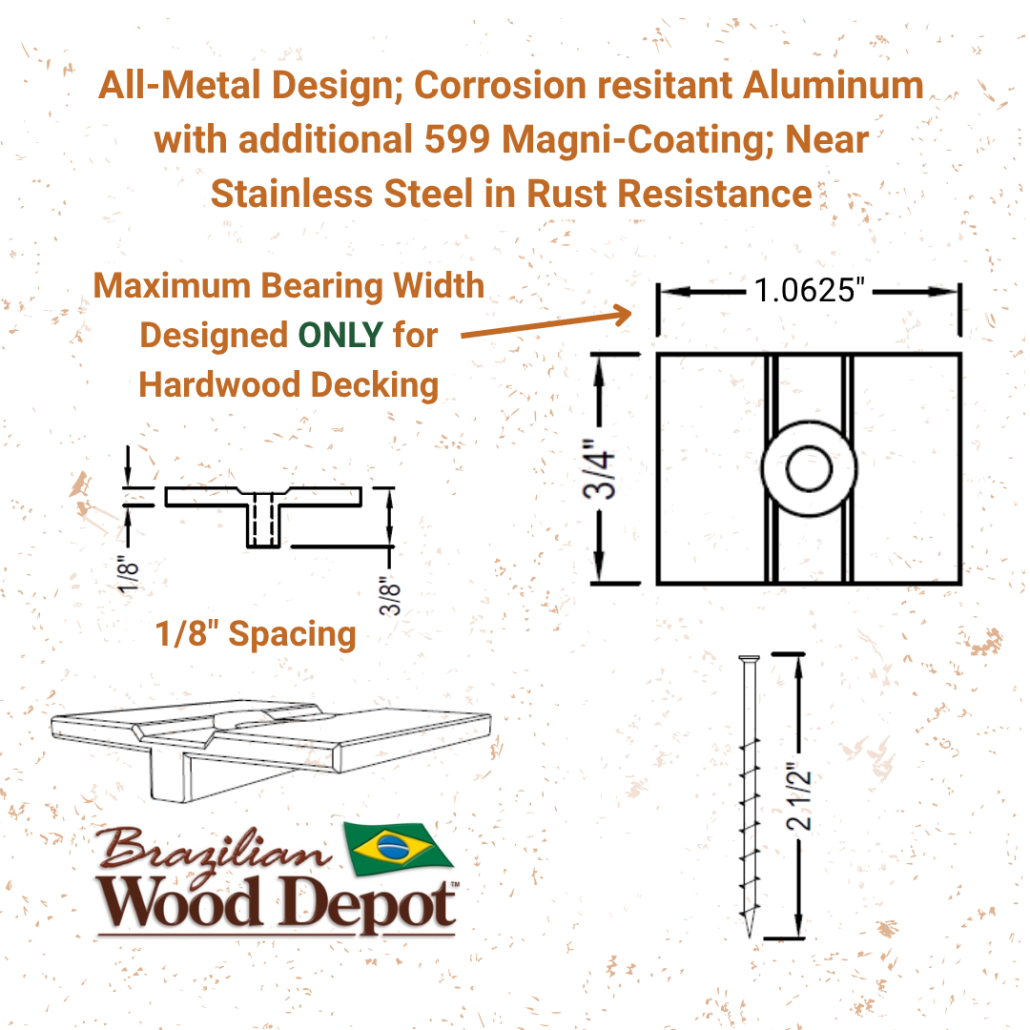
| Clip Bearing Width | 1-1/16″ total width (bearing approximately 15/16″ after 1/8″ spacing downstem) | 1″ total width (bearing: 29/32″ std. / 27/32″ S) | 3/4″ gusset width (bearing approximately 9/16″ after 3/16″ spacing) | Not specified (estimated ~3/4″ to 1″ total width with 3/16″ spacing) | Not specified (appears ~5/8″ total width; effective bearing reduced further depending on spacing used) | Approximately 5/8″ total width (about 3/8″ bearing with minimum 3/16″ groove requirement) |
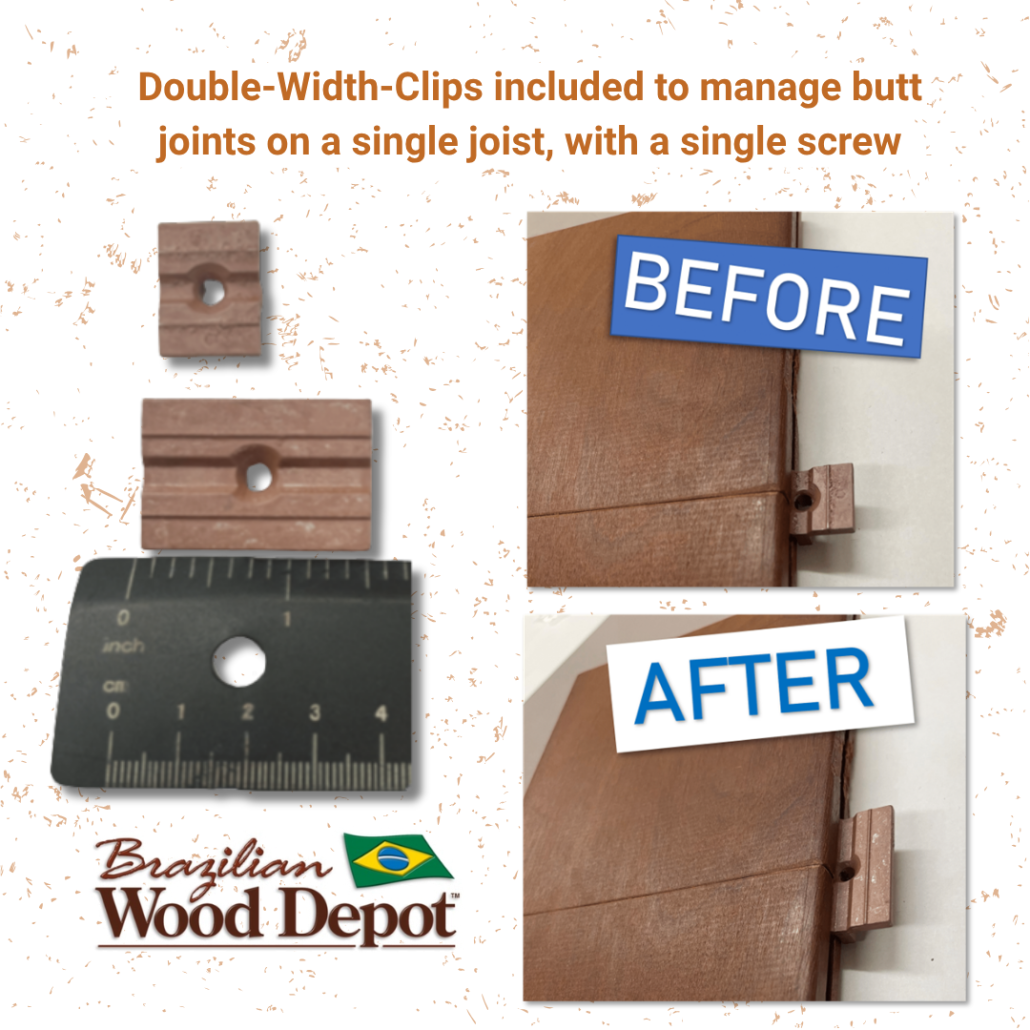
| Butt Joint Solution (Single Joist) | Yes — double-width clips included in each package for butt joints or full-deck use | No — no dedicated butt-joint solution on a single joist | No — no dedicated butt-joint solution on a single joist | Not specifically defined (biscuit-style connection may allow it) | Yes — requires TC-150 clips (typically four clips per butt joint) | Not specified (clip length may allow it, but no defined system guidance) |
| Starter System Included | No starter clip required | Yes | Yes | No | No | No |
| Integrated Trim System | Yes — Pro Plug System (sold separately) or GRK stainless steel trim screws recommended | Yes — 3/8″ plug system (requires separate Forstner bit; multi-step process) | No integrated trim or plug system offered | Yes — dowel plug system (reciprocating saw method) | No integrated system (surface screws or deck screws recommended) | Not addressed (likely requires surface fastening at perimeter) |
| Designed For | Hardwood-specific — engineered for dense hardwood decking only and is not compatible with composite decking. | Wood and composite decking | Wood, PVC, composite, and capped composite decking | Kiln-dried decking only (approximately 19% moisture content or less) | Grooved decking (hardwood, composite, PVC) | Grooved decking (hardwood, composite, PVC) |
BWD Deck Clips (For Hardwoods Only)
The BWD Clip system is specifically engineered for hardwood decking applications, not adapted from composite or general-purpose systems. That hardwood-first design shows up clearly in installation speed, hold-down strength, long-term serviceability, and overall system flexibility. *This clip is exclusively available to Brazilian Wood Depot hardwood decking customers*
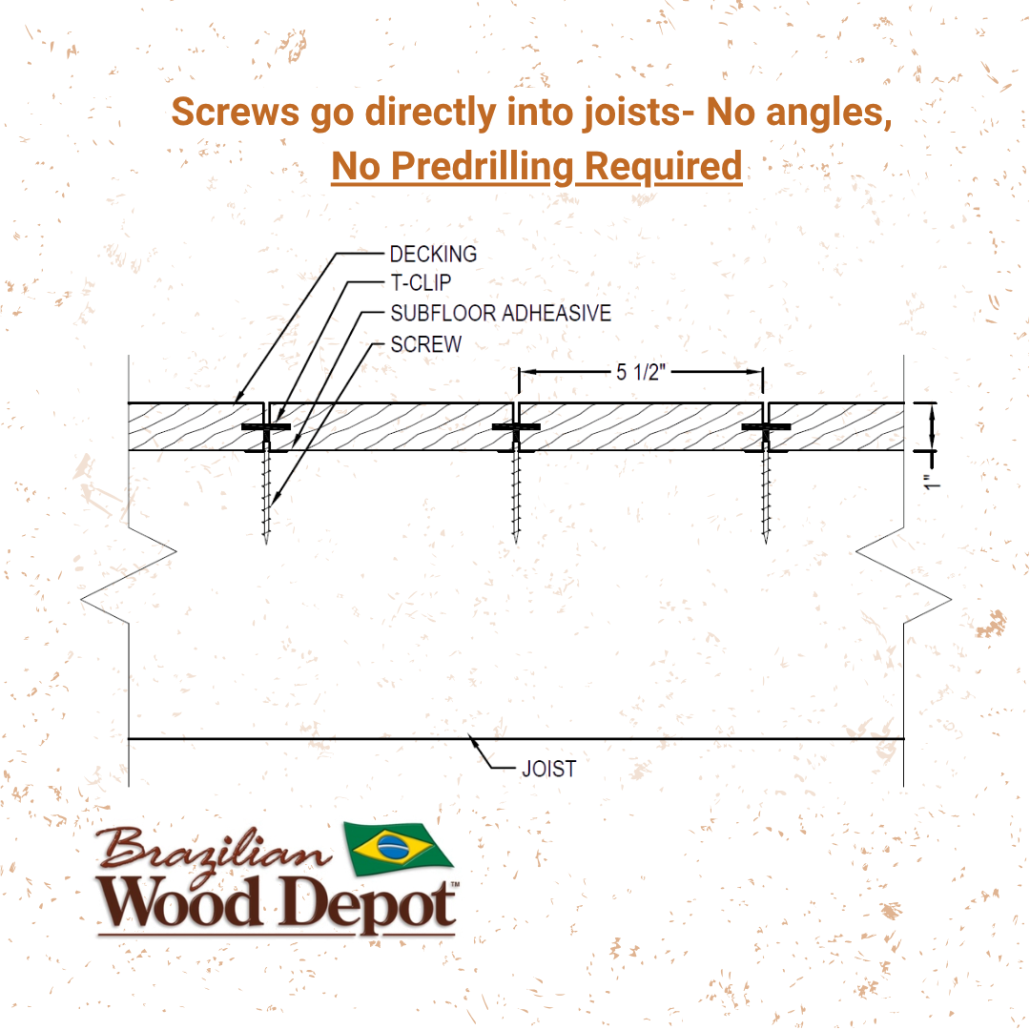
- No pre-drilling required — the fastener drives straight down into the joist instead of going in at an angle, helping reduce labor and speed up installation.
- Straight-down fastening creates a more natural and controlled installation process than angled clip systems.
- Installer-friendly design includes a narrow-neck drive bit that fits cleanly within the 1/8” spacing, keeping both the bit and screw head accessible during installation.
- That combination is a major reason why contractors consistently prefer this system over more consumer-grade clip options.
- Overall Ease of Use: 9–10 / 10
- Fastener remains accessible after installation, allowing individual boards to be removed without disturbing adjacent boards.
- This is a major advantage over systems where fasteners are buried or become inaccessible once the deck is installed.
- When paired with adhesive, removal can take more effort, but it still avoids the need to remove multiple boards in sequence.
- It also helps reduce the risk of damaging surrounding boards during service work.
- Board Replacement Rating: 9–10 / 10
- Hardwood-specific design — engineered for dense species like Ipe and Cumaru rather than adapted from lighter-duty systems.
- Maximum bearing surface helps improve board stability and reduce movement over time.
- All-metal construction eliminates plastic components that can flex, fatigue, or degrade.
- The result is strong, consistent hold-down pressure across the deck surface.
- Hold-Down Performance: 10 / 10
- Solid metal downstem helps control spacing and alignment throughout installation.
- Unlike plastic or hybrid systems, the spacing mechanism cannot compress or deform under load.
- That helps maintain more consistent board spacing across the deck surface.
- The result is a more forgiving installation process with less variability from board to board.
- High margin for error compared to flexible clip systems
- Designed to work as part of a complete fastening system, not just as a field clip.
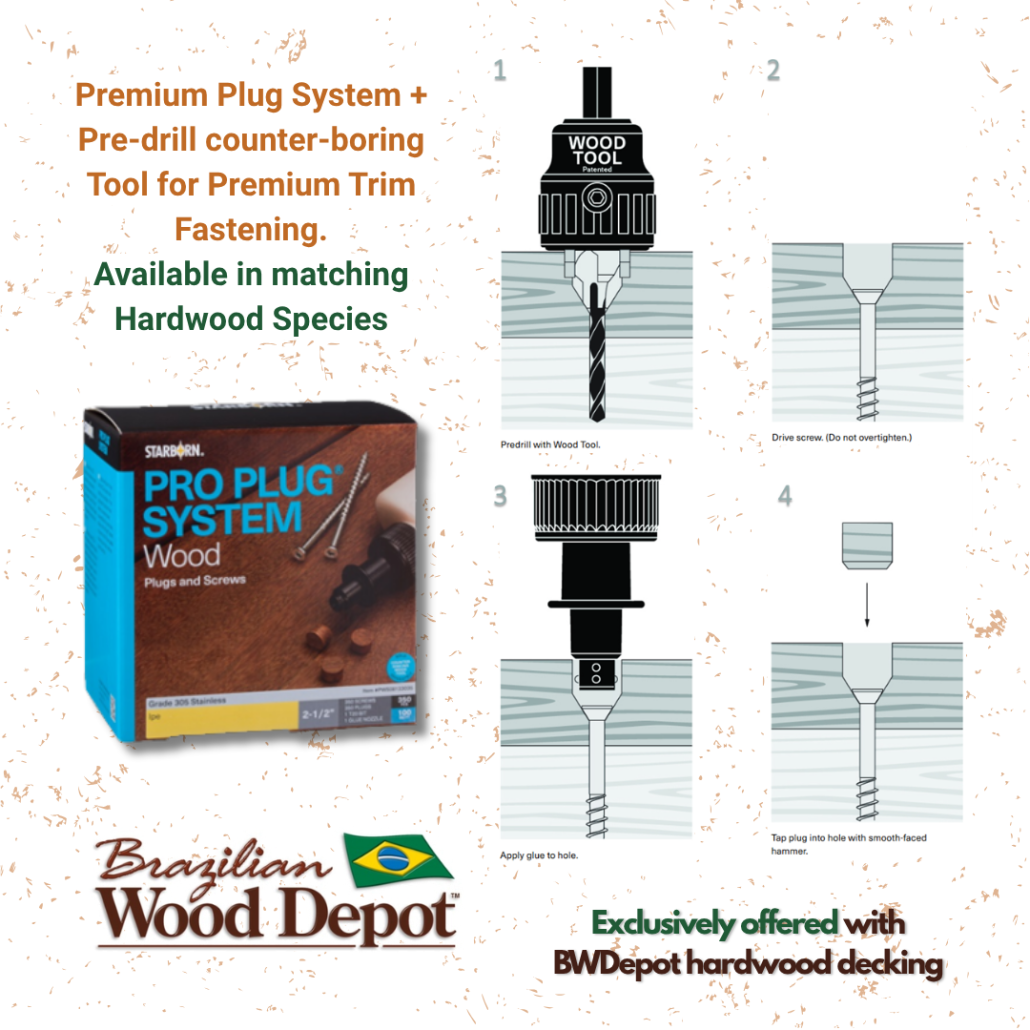
- It is commonly paired with the Pro Plug System for clean concealed face fastening at perimeters and transitions.
- Stainless steel trim screws can also be used for starters, trim details, and stair applications.
- This creates more flexibility, a cleaner finished appearance, and better handling of edge conditions.
- Rather than forcing one rigid method everywhere, it lets installers choose the best fastening approach for each part of the deck.
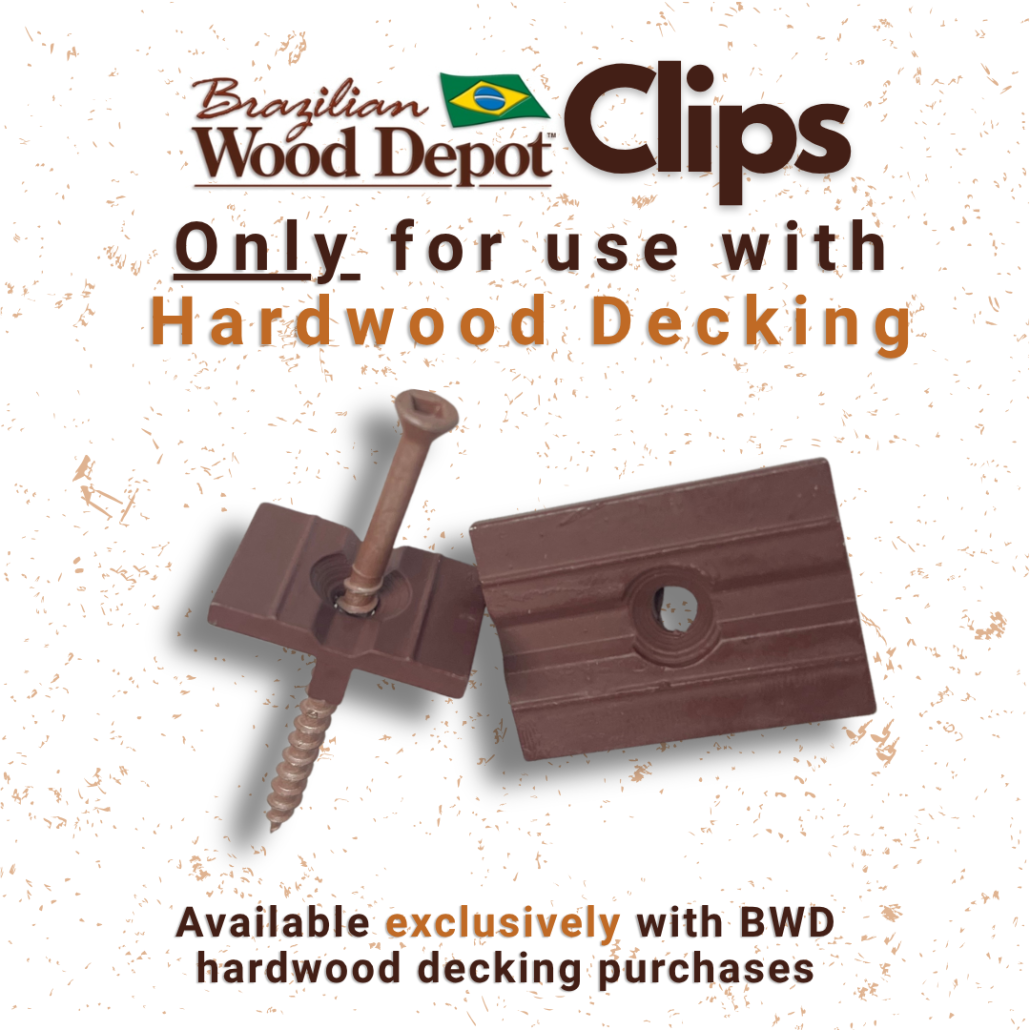

- Purpose-built for hardwood decking only — not adapted from composite or general-purpose systems.
- No pre-drilling required with straight-down fastening into the joist, helping simplify installation and reduce labor.
- All-aluminum construction with 599 Magni coating provides strong corrosion resistance, approaching stainless steel performance without the same added cost or material softness.
- Solid metal downstem cannot compress, helping maintain consistent spacing and alignment during installation.
- Widest clip bearing surface among the compared systems, supporting stronger hold-down performance for dense hardwoods.
- Fastener remains accessible, making board replacement much easier than with most competing clip systems.
- Only system designed to effectively handle butt joints on a single joist using a dedicated clip solution.
- Flexible perimeter and trim fastening options include the Pro Plug System for premium concealed fastening and stainless steel trim screws for installer flexibility.
- Complete fastening system approach — designed to work across field fastening, perimeter conditions, and transition details.
IpeClip Extreme
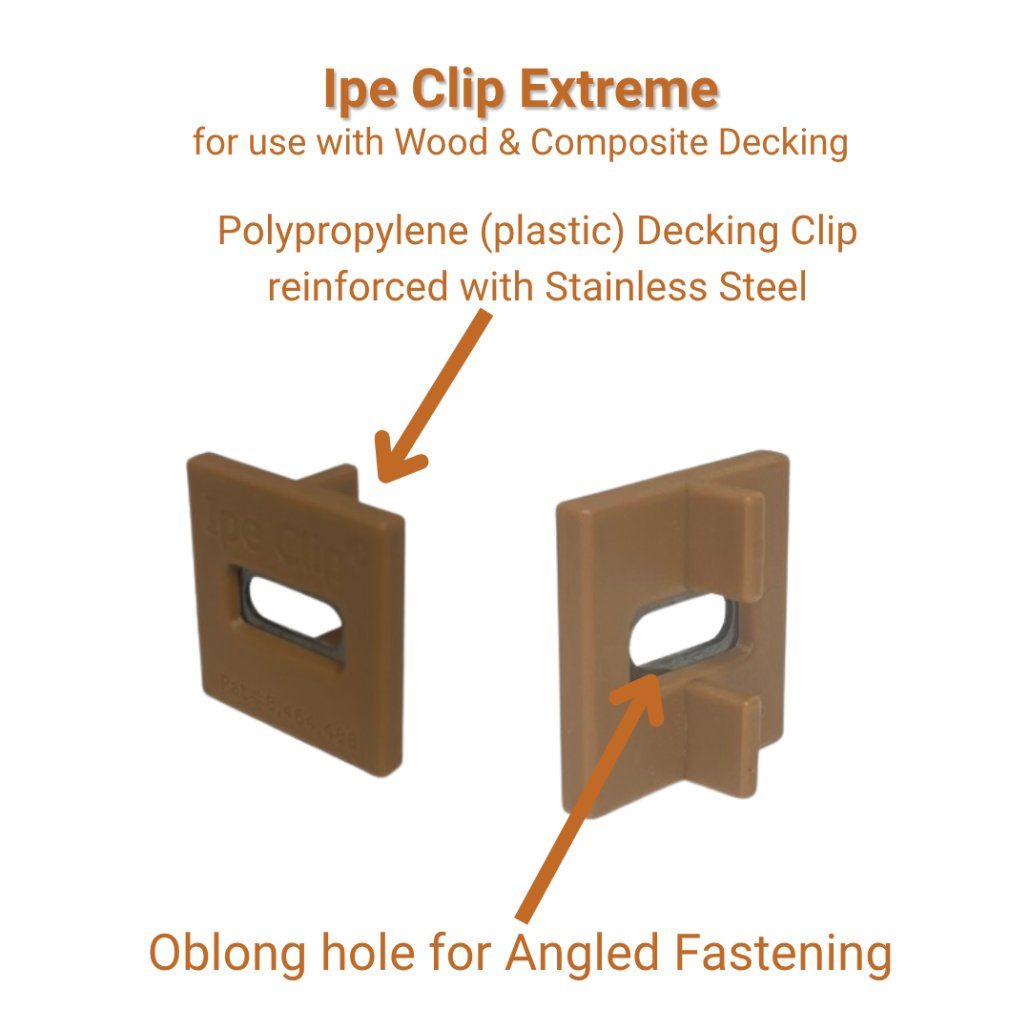
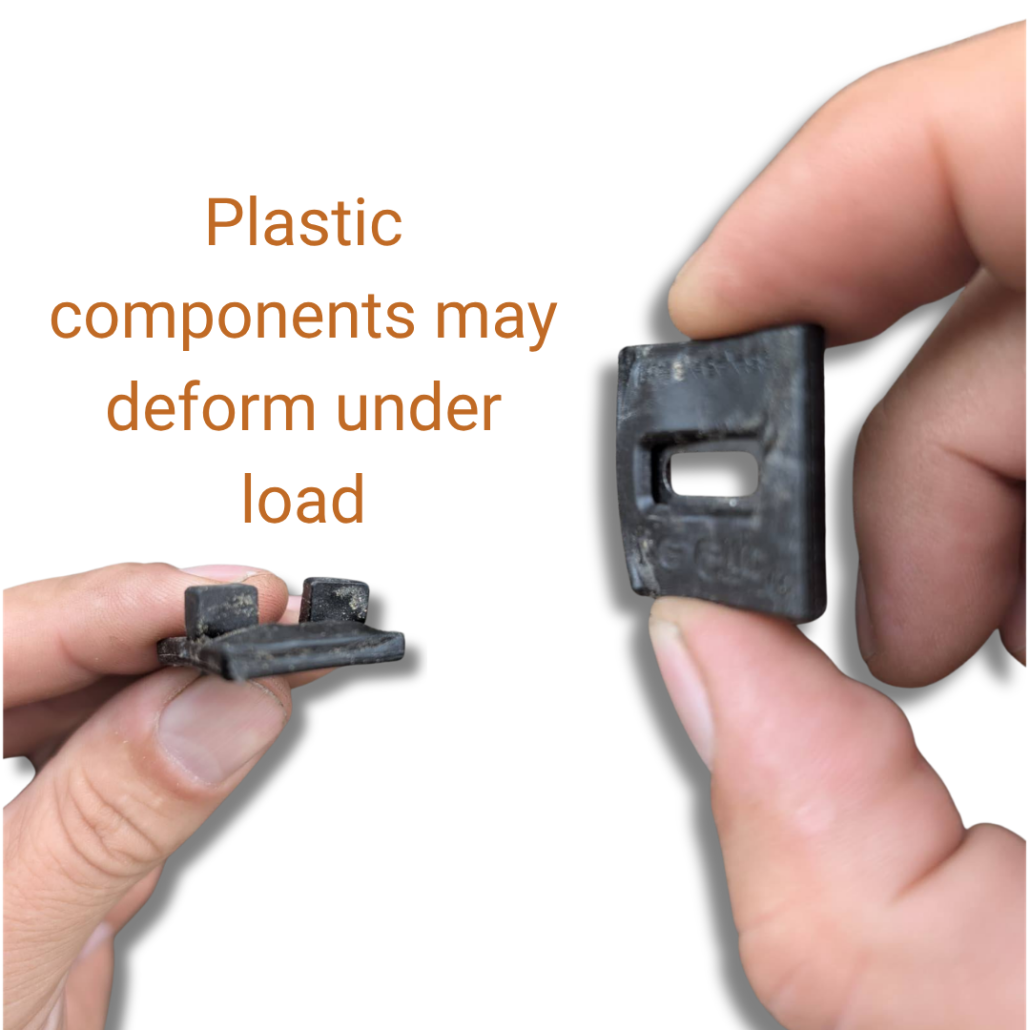
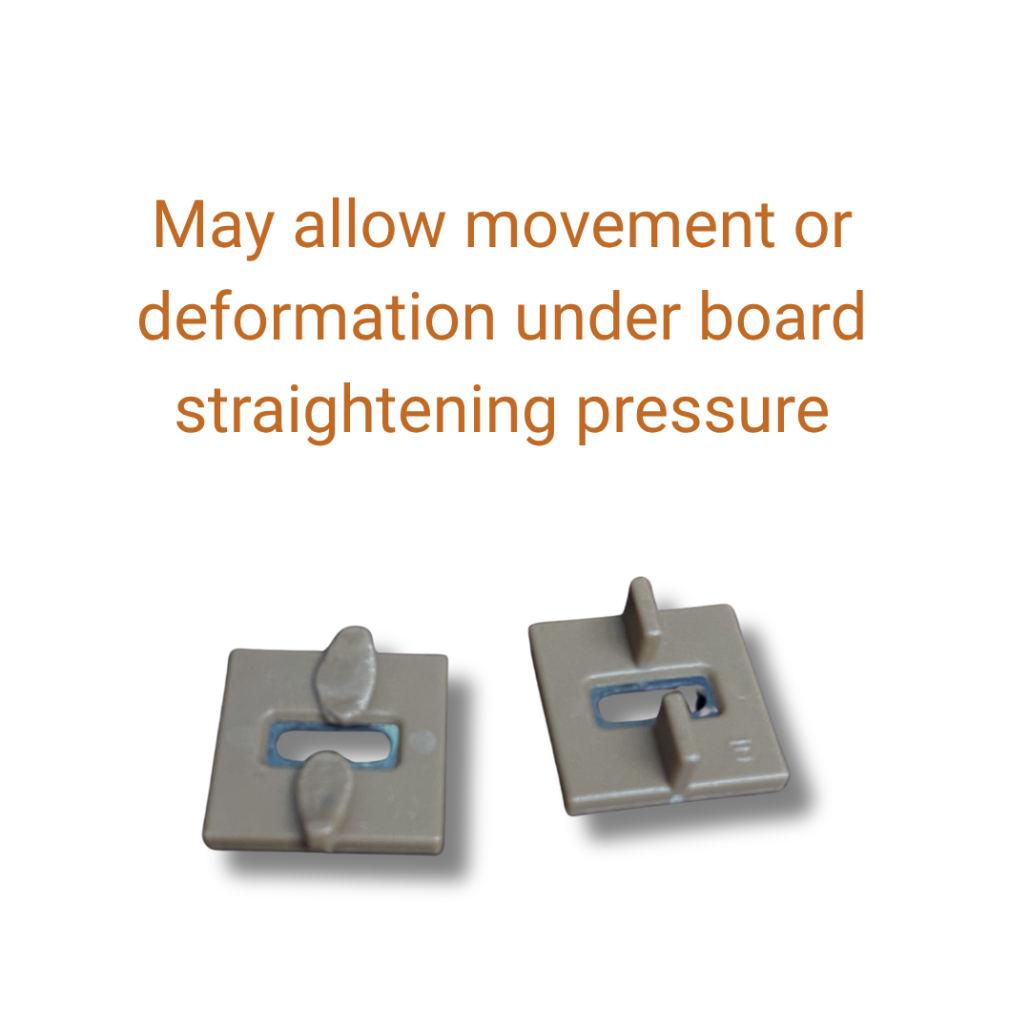
The Ipe Clip Extreme system is one of the more established hidden fastener options in the hardwood space. It uses a plastic body with stainless steel reinforcement and is available in two spacing variations. While it offers a more packaged system, there are still tradeoffs in installation complexity, board replacement, and overall long-term flexibility.
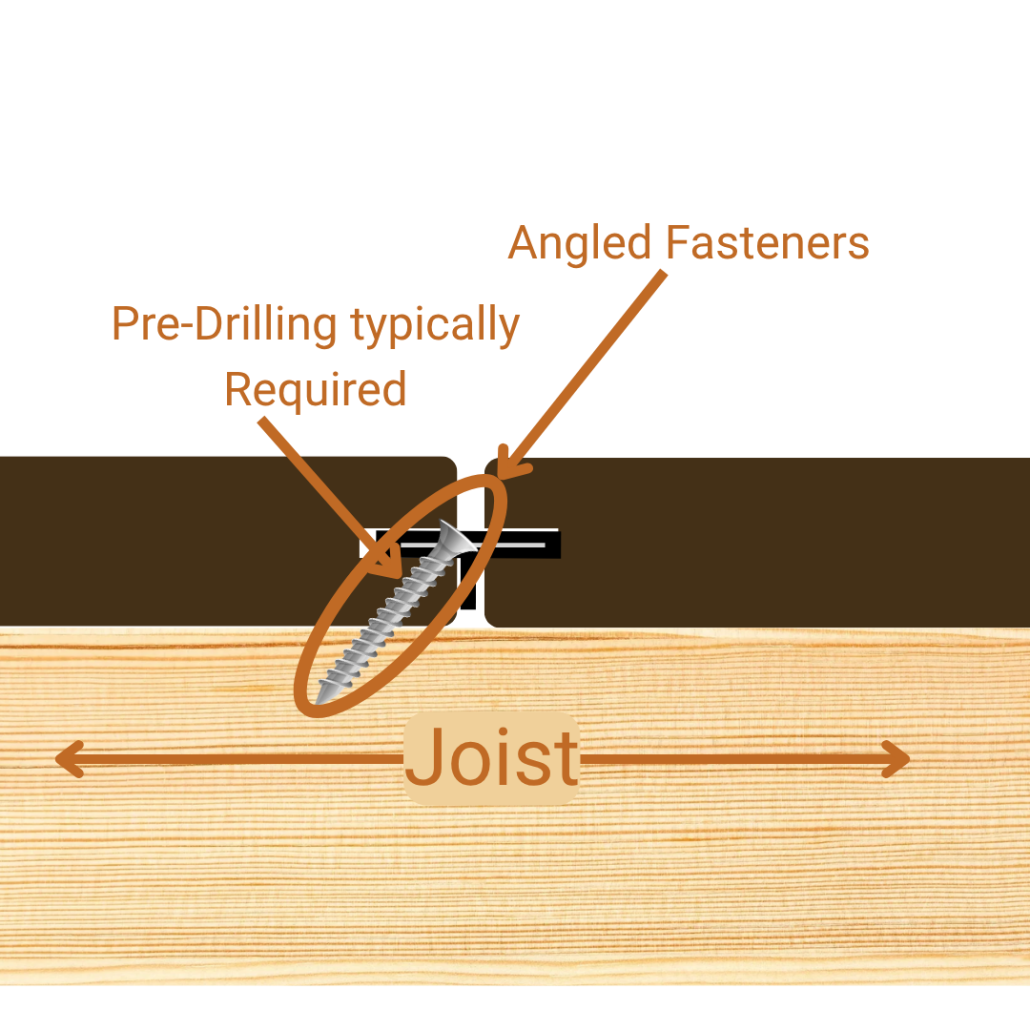
- Pre-drilling is required, which adds time and labor to the installation process.
- Angled fastening at approximately 45° is less natural and can be more difficult to control than straight-down systems.
- Some installers may skip pre-drilling, but that can increase the risk of cracking the bottom of the board and creating more stress during seasonal movement.
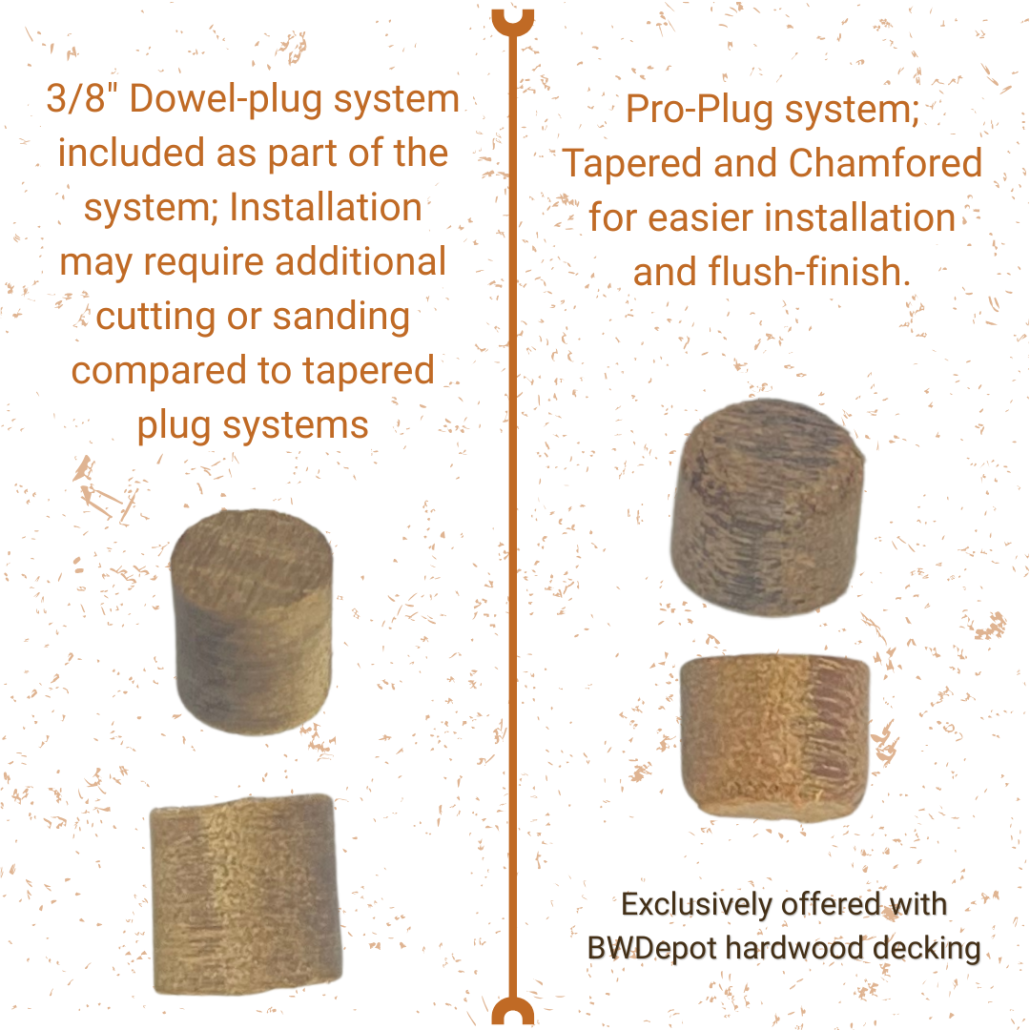
- The included plug system is functional, but it is less user-friendly than the Pro Plug System because of the extra steps and tooling involved.
- Ease of Use: 7 / 10
- Fastener heads are not accessible after installation.
- Removing a single board may require disturbing adjacent boards or working backward through the installation sequence.
- That increases labor and makes repairs or adjustments more complicated than with serviceable-access systems.
- This is one of the main tradeoffs of the system from a long-term maintenance standpoint.
- Board Replacement: 6 / 10
- The system provides decent hold-down strength, supported by its stainless steel reinforcement.
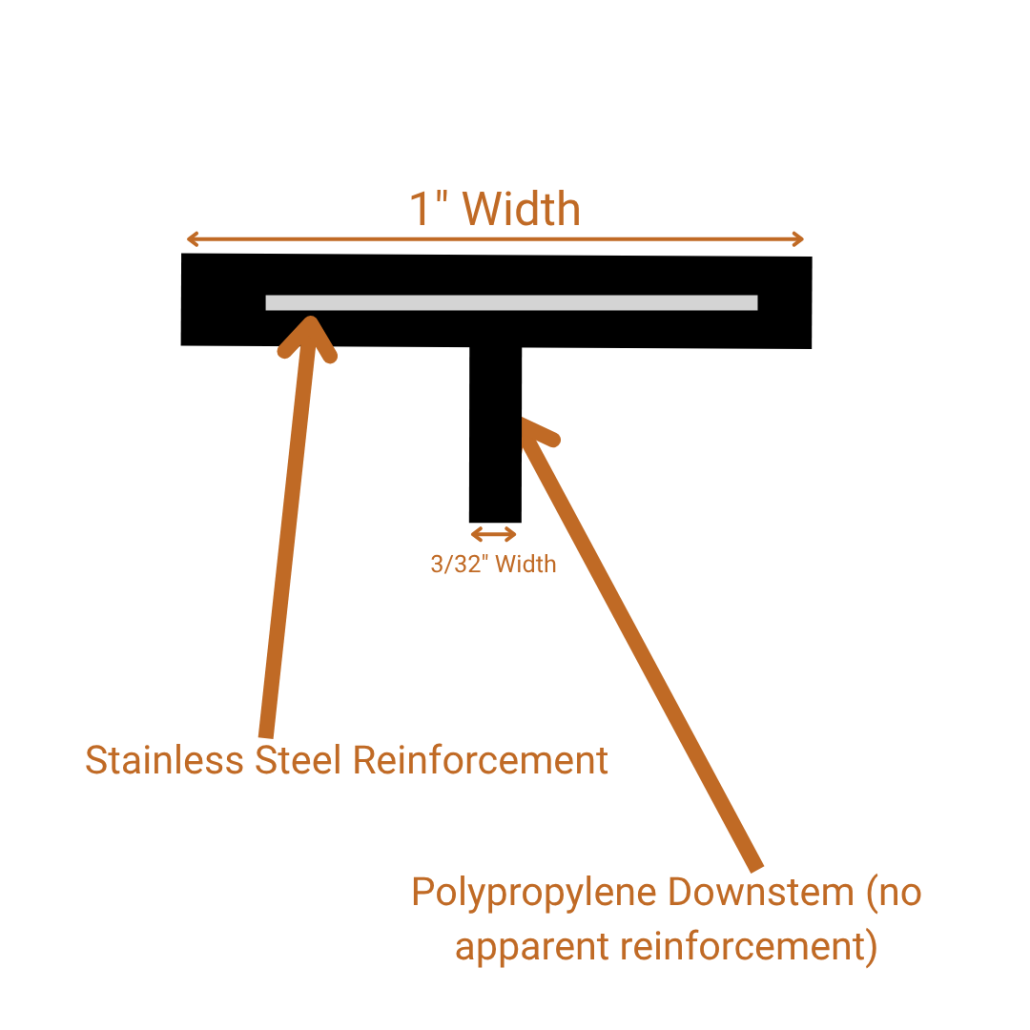
- Its effective bearing surface is reduced by the spacing design: a 1” clip width minus either 3/32” or 5/32” spacing.
- That leaves approximately 29/32” or 27/32” of bearing surface, depending on the version used.
- Single-side fastening adds stability, but it still does not fully offset the reduced bearing width compared with wider hardwood-specific clip systems.
- Hold-Down Performance: ~8.5 / 10
- The system uses a plastic downstem to control spacing.
- The standard version uses solid plastic and is relatively stable under normal installation conditions.
- The “S” variant uses a hollow core and is more susceptible to compression under load.
- Compared with rigid metal spacing systems, plastic components introduce more variability and less forgiveness across the deck surface.
- Installation Margin for Error: Moderate
- This system is sold as a complete package, typically including clips, screws, plugs, and related drill or drive components.
- That makes it convenient for installers who prefer an all-in-one solution rather than assembling components separately.
- However, the system is built around the assumption that plug fastening will be used for trim and perimeter work.
- If an installer prefers other methods, such as trim screws, those parts must usually be sourced separately.
- System Completeness: 9 / 10
For full product details, visit the manufacturer’s page: https://www.deckwise.com/ipe-clip-extreme-hidden-deck-fastener.html
- More complex installation due to pre-drilling and angled fastening.
- Limited board replacement flexibility because the fasteners are not accessible after installation.
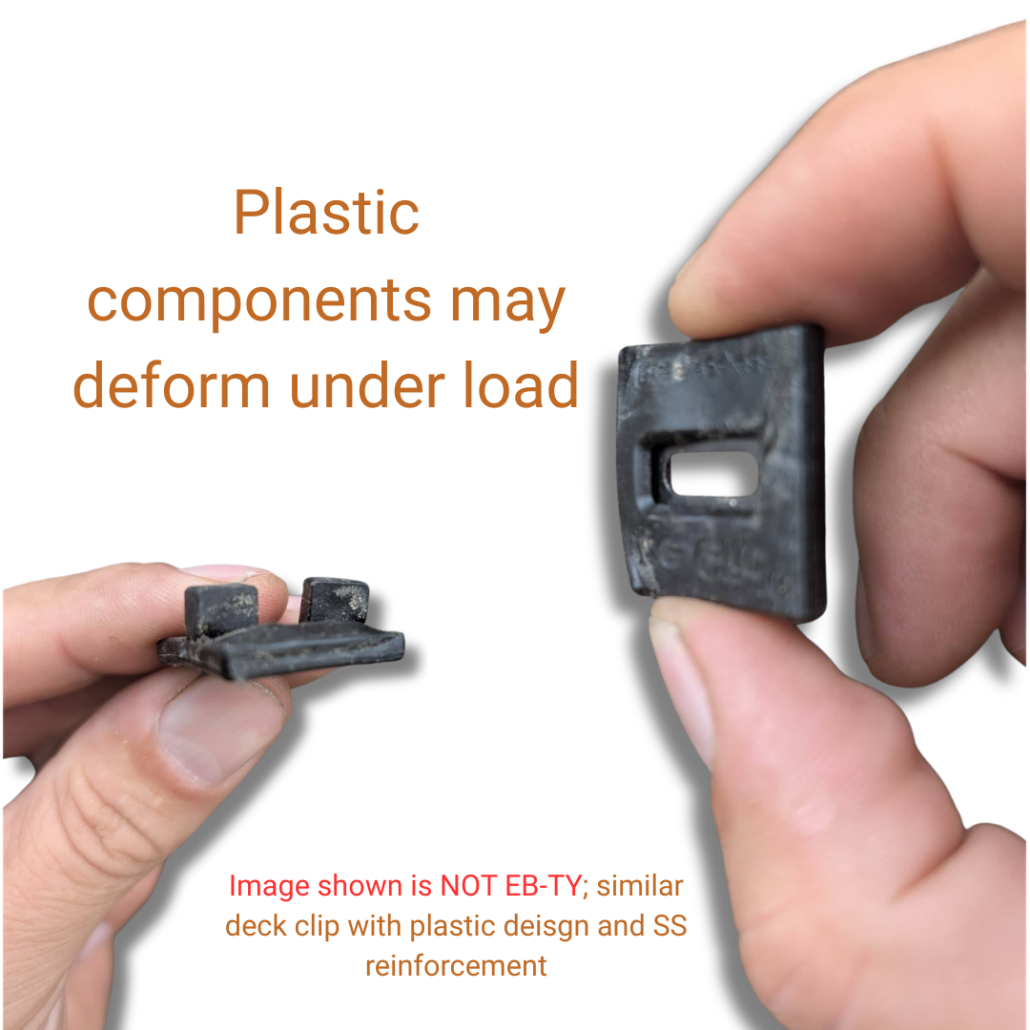
- Plastic-based clip design with stainless reinforcement rather than full metal construction.
- A strong packaged system overall, but less flexible in approach than more modular fastening systems.
Disclaimer: All product names, trademarks, and brands are the property of their respective owners and are used for identification purposes only. This comparison is based on general product design characteristics and publicly available information at the time of writing. No affiliation or endorsement is implied. Performance may vary depending on installation methods, materials, and site conditions. For complete specifications and installation instructions, please refer to the manufacturer’s official documentation.
CAMO Edge Clips
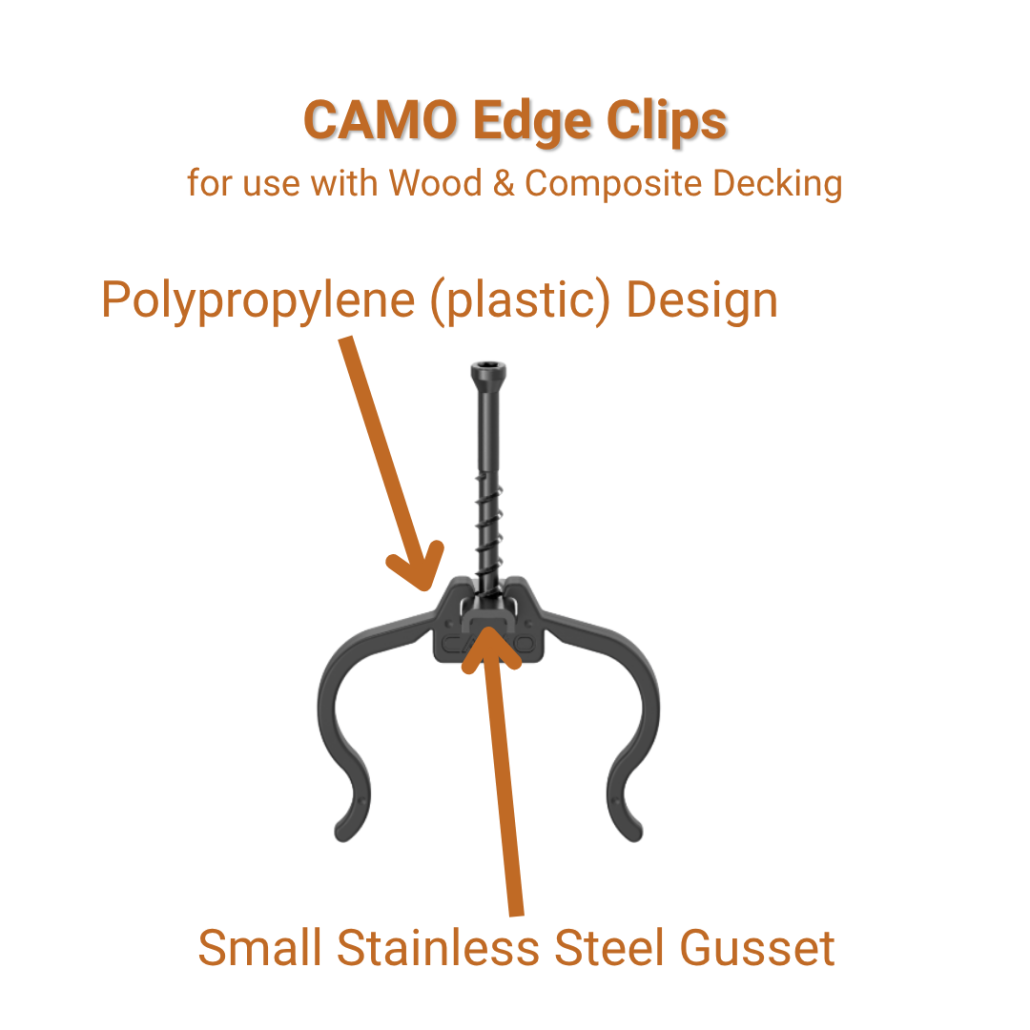
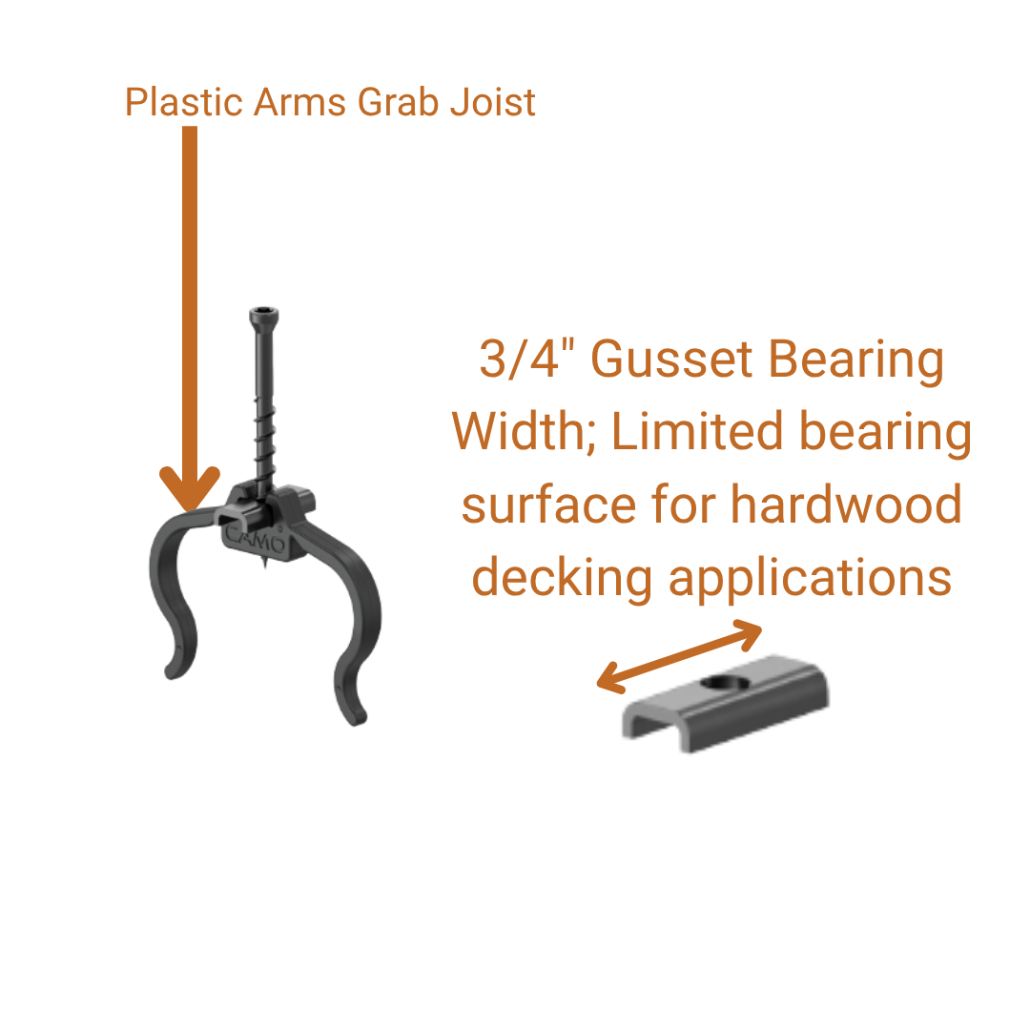
The Camo Edge Clip system is widely used and recognized for its ease of installation. It features a primarily plastic construction with a small stainless steel gusset and is designed to work across wood, PVC, and composite decking. While it performs well in certain areas, its design shows clear limitations when applied to dense hardwood decking.
- Straight-down fastening makes installation intuitive and efficient.
- No pre-drilling required, which helps reduce labor time compared with angled or pre-drill systems.
- Clip retention arms help grip the joist and keep clips from falling out of place during installation.
- Overall, this system is very installer-friendly and performs well during install.
- Ease of Use: 10 / 10
- Screw heads are accessible, allowing boards to be removed without fully dismantling surrounding boards.
- In most cases, individual boards can be removed unless spacing is too tight to reach the screw or a drive bit cannot fit comfortably between boards.
- That makes repairs and adjustments relatively straightforward compared with systems that bury the fastener completely.
- Board Replacement: 9 / 10
- This is where the system shows its biggest limitation.
- Narrow clip wingspan reduces the amount of bearing surface holding the board in place.
- The design is better suited for composite decking, which behaves differently than dense hardwood.
- No adhesive integration means adhesive is not part of the recommended installation method.
- As hardwood boards expand and contract, boards may shift off centerline, gaps can become inconsistent, and the risk of lifting or clip disengagement increases.
- Hold-Down Performance: 4 / 10
- Rigid spacing design helps provide relatively consistent spacing during installation.
- The clip does not appear especially prone to compression under normal install conditions.
- However, if boards are forced too tightly together, seasonal movement can increase the chance of boards disengaging from the clip.
- Installation Margin for Error: 7 / 10
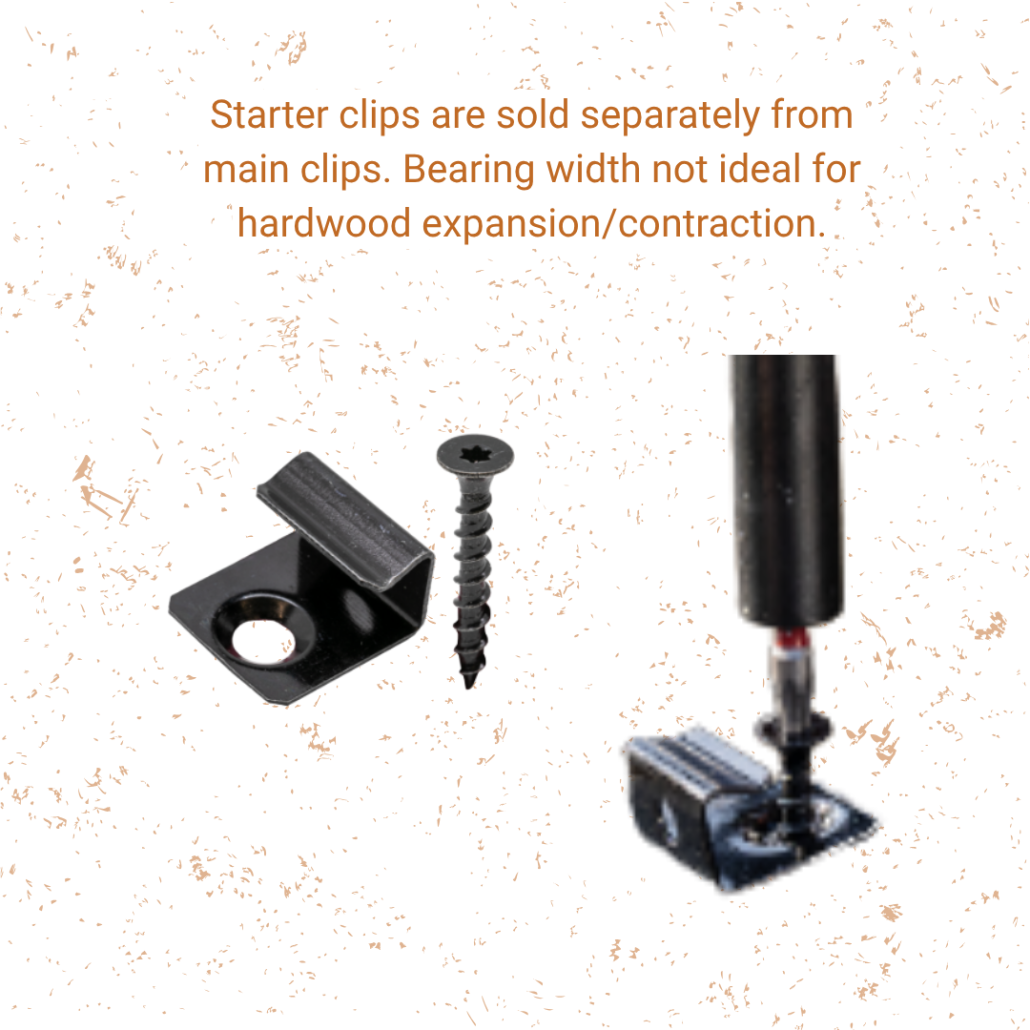
- The system includes a starter clip as part of the package.
- That starter clip provides both alignment and hold-down function, which is a useful feature.
- However, like the main clip, it appears to be designed primarily for composite applications.
- No integrated trim fastening solution means perimeter and finishing details still need to be handled separately.
- System Completeness: 8–9 / 10
For full product details, visit the manufacturer’s page: https://www.camofasteners.com/products/clips/edge-clips/
- Excellent ease of use, especially for installers familiar with composite systems.
- Accessible fasteners make board replacement relatively simple.
- Hold-down performance is limited because of the narrow bearing surface and lack of adhesive integration.
- Primarily plastic construction with minimal metal reinforcement.
- Best suited for composite and lighter-duty applications, rather than dense hardwood decking.
Disclaimer: All product names, trademarks, and brands are the property of their respective owners and are used for identification purposes only. This comparison is based on general product design characteristics and publicly available information at the time of writing. No affiliation or endorsement is implied. Performance may vary depending on installation methods, materials, and site conditions. For complete specifications and installation instructions, please refer to the manufacturer’s official documentation.
Simpson EB-TY Clips
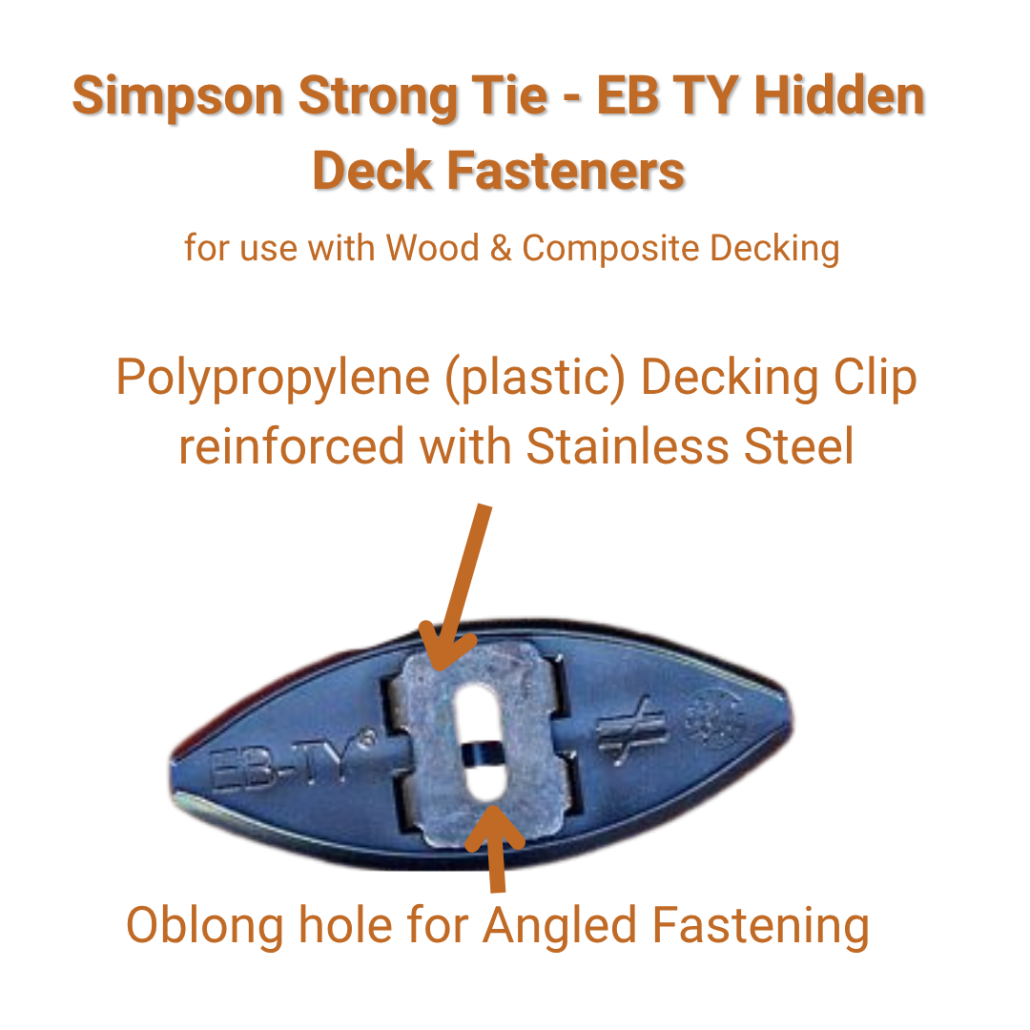
The EB-TY system by Simpson Strong-Tie is a well-known hidden fastener designed for kiln-dried decking. It uses a polypropylene (plastic) biscuit-style clip with stainless steel reinforcement and incorporates adhesive as part of its recommended installation process. While it delivers solid performance in some areas, there are clear tradeoffs in accessibility, installation efficiency, and long-term flexibility.
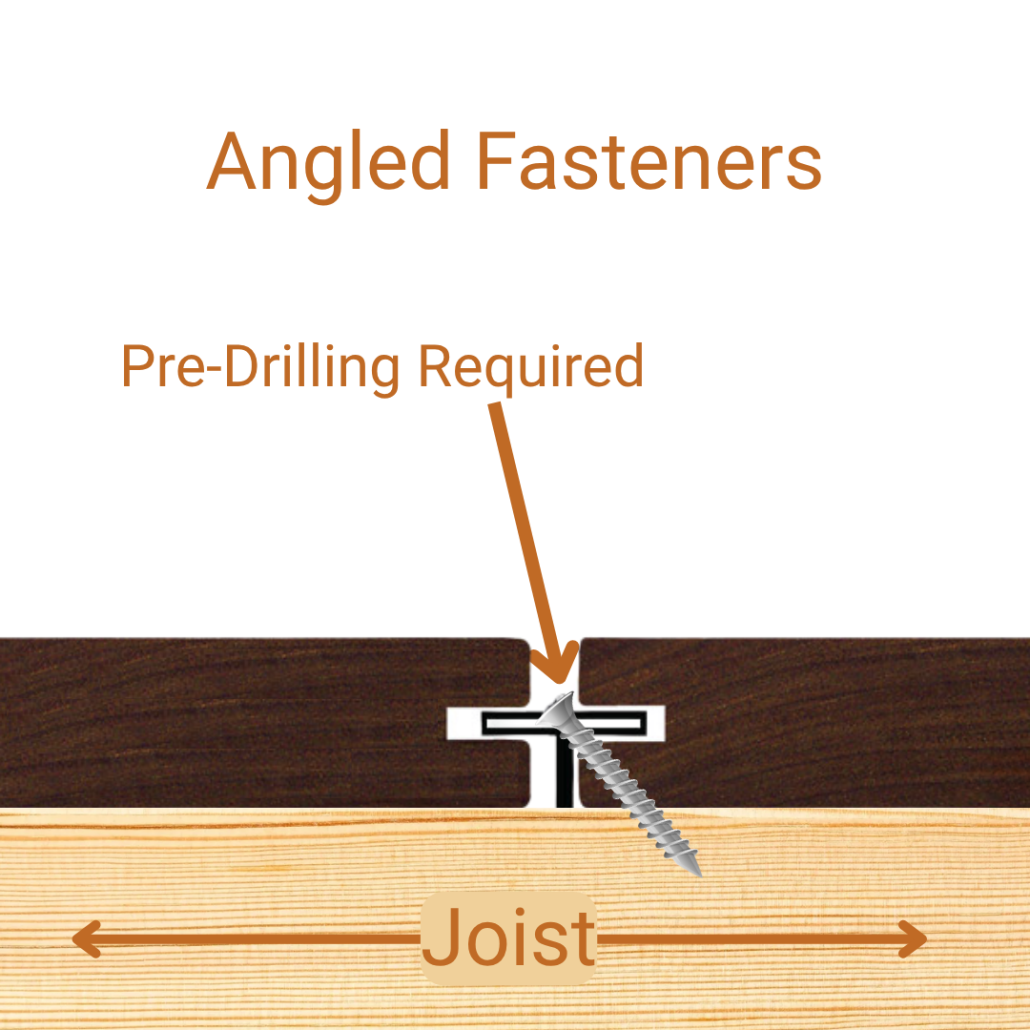
- Pre-drilling is required, adding time and labor to the installation process.
- Angled fastening is less intuitive and more time-consuming than straight-down systems.
- The system requires more precision during installation compared to simpler clip designs.
- Ease of Use: 7 / 10
- Fastener heads are not accessible after installation.
- Board replacement typically requires removing adjacent boards in sequence or cutting the board out.
- Replacement boards are often face-screwed, since reinstalling clips mid-field is not practical.
- This reduces flexibility and increases labor for future repairs or adjustments.
- Board Replacement: ~6–7 / 10
- Provides solid hold-down performance, supported by adhesive integration.
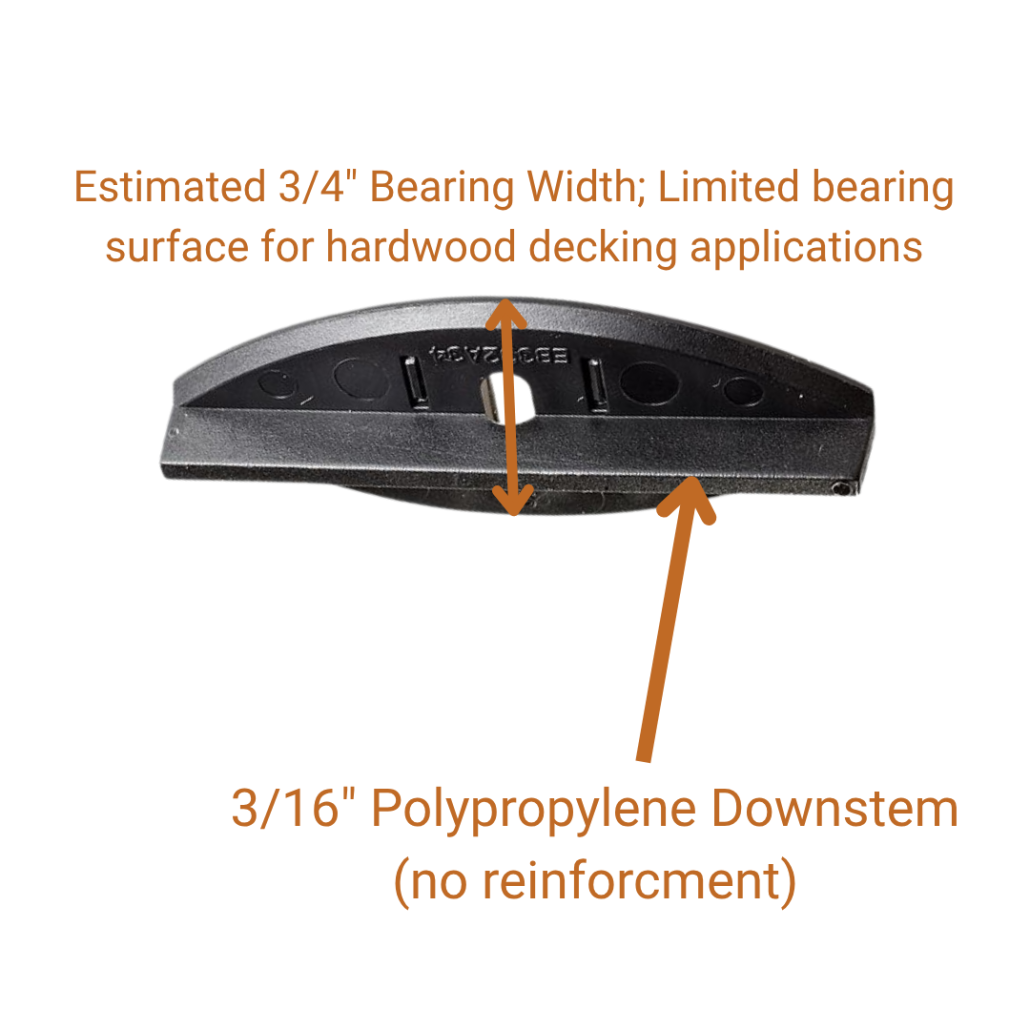
- Clip width appears to be in the range of 3/4” to 1” with a 3/16” spacing gap.
- This allows for reasonable movement, though not as robust as wider-bearing hardwood-specific systems.
- Butt joint performance is unclear, especially with the oval biscuit design on a single joist.
- Adhesive improves hold-down but reduces long-term serviceability.
- Hold-Down Performance: ~8 / 10
- Plastic downstem helps control spacing but is less rigid than metal systems.
- Clips may shift during installation, especially when using board straightening tools.
- Material flexibility introduces some variability compared to rigid metal spacing systems.
- Installation Margin for Error: Moderate
- Does not include a dedicated starter clip as part of the system.
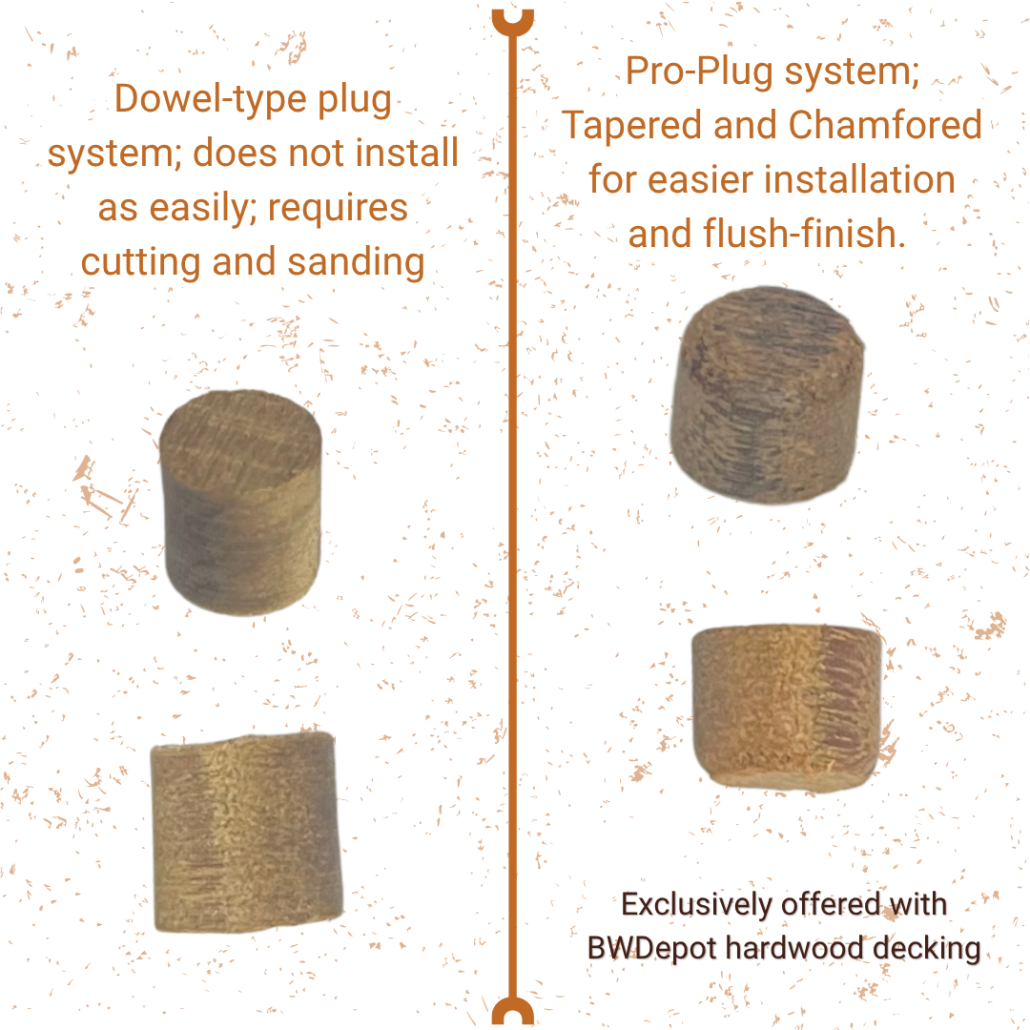
- Simpson references a dowel-style plug system for surface fastening.
- This requires cutting plugs flush, typically with a reciprocating saw, making it more labor-intensive.
- It is less refined and less user-friendly than systems like the Pro Plug System.
- Overall, the system is functional but less polished in trim and finishing applications.
For full product details, visit the manufacturer’s page: https://www.strongtie.com/products/go/fasteners/ebtypremium-hidden-deck-fasteners
- Plastic (polypropylene)-based clip allows some flexibility during installation.
- Angled fastening and pre-drilling increase installation time and complexity.
- Board replacement is more difficult due to inaccessible fasteners.
- No dedicated starter system included.
- Plug system is less intuitive and more labor-intensive compared to premium solutions like Pro Plug.
Disclaimer: All product names, trademarks, and brands are the property of their respective owners and are used for identification purposes only. This comparison is based on general product design characteristics and publicly available information at the time of writing. No affiliation or endorsement is implied. Performance may vary depending on installation methods, materials, and site conditions. For complete specifications and installation instructions, please refer to the manufacturer’s official documentation.
TigerClaw Deck Clips
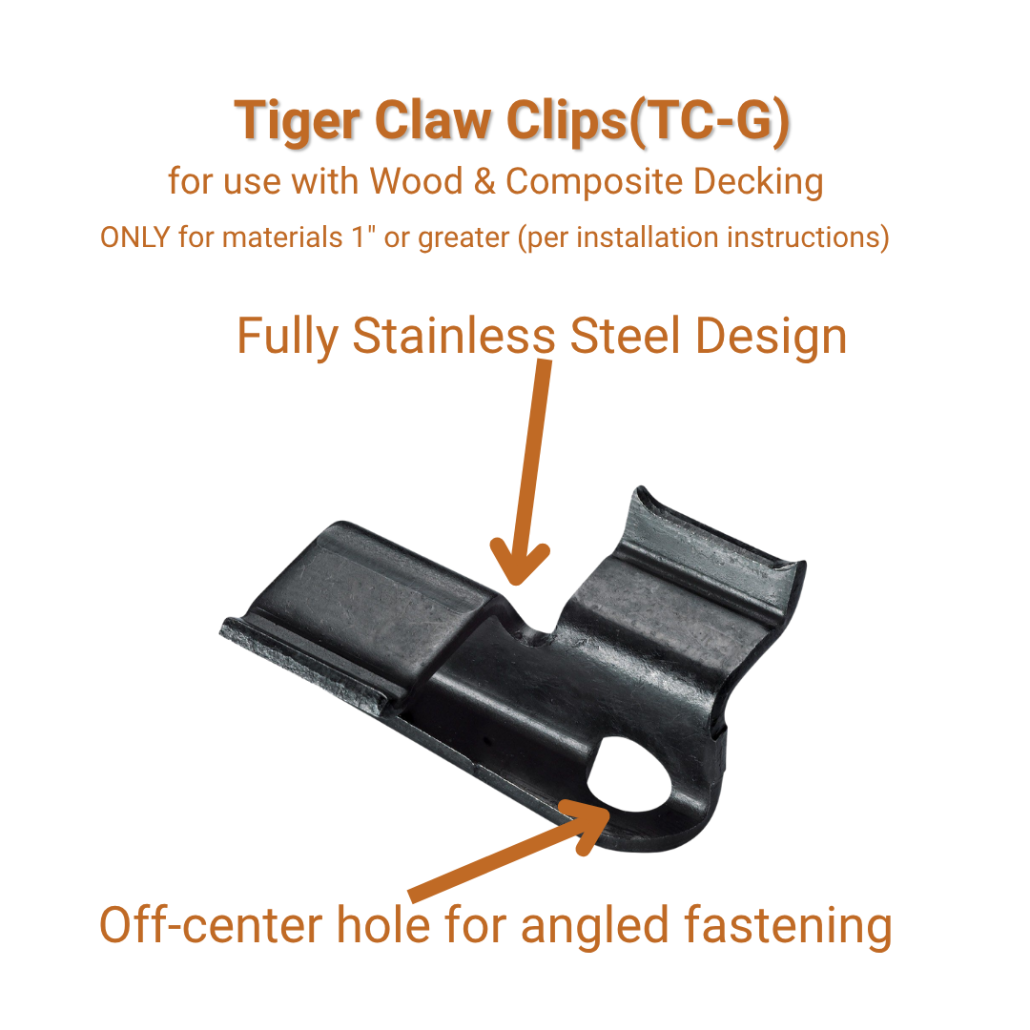
The Tiger Claw TC-120 system is a folded stainless steel clip that relies on a spring-like mechanism to hold decking boards in place. It is commonly used across multiple decking types and can be paired with the TC-150 clip for butt joints. While it performs adequately in some areas, its design raises concerns when applied to dense hardwood decking.
- No pre-drilling required for most installations.
- Fasteners are driven at an angle and positioned near the joist edge, making installation less intuitive than straight-down systems.
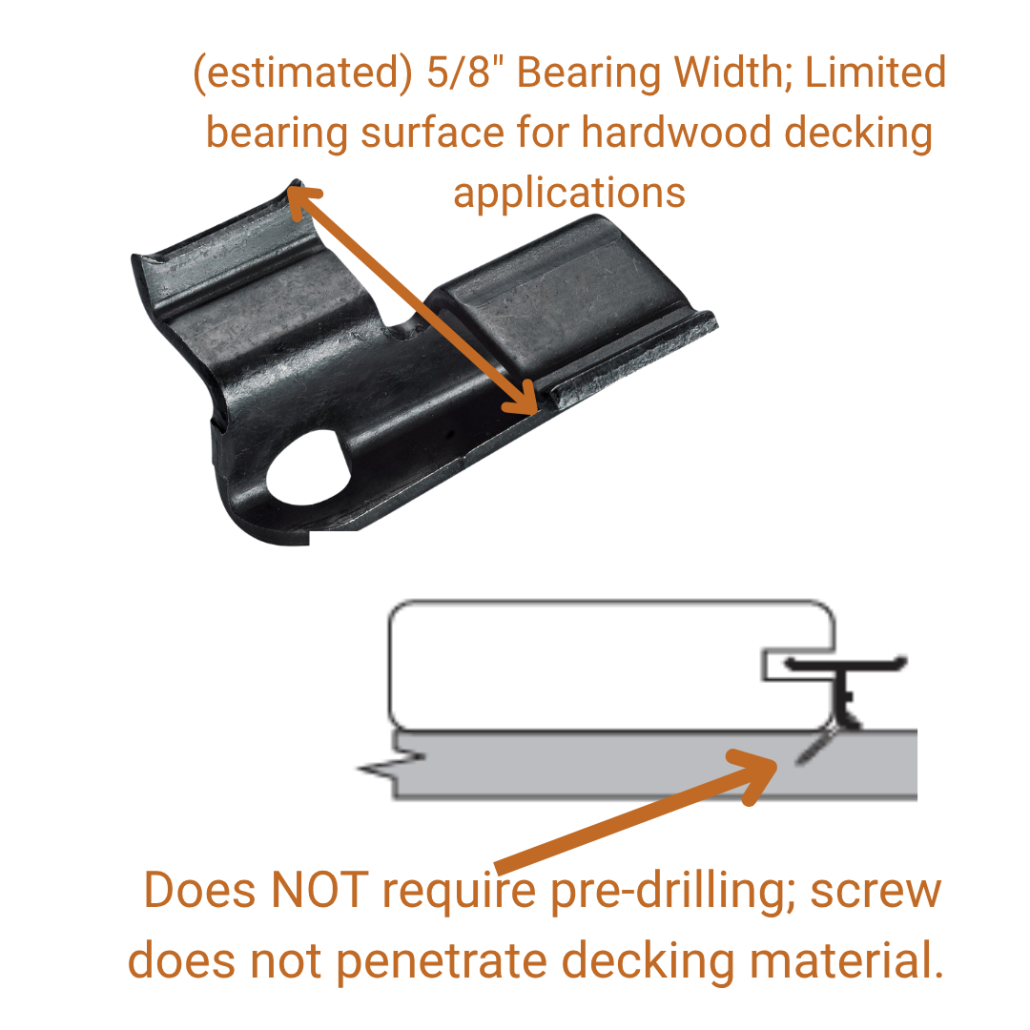
- The system relies on a spring-like tension mechanism created by the folded metal design.
- Installation is relatively efficient but requires careful positioning and alignment.
- Ease of Use: 9 / 10
- Fastener heads are not accessible after installation and sit below the decking surface.
- Board removal typically requires removing adjacent boards or cutting out the board.
- Even without adhesive, limited access makes repairs more time-consuming.
- Board Replacement: ~7 / 10
- Uses a spring-tension mechanism rather than relying on a wide bearing surface.
- The overall clip wingspan appears relatively narrow.
- This raises concerns with dense hardwood movement and seasonal expansion.
- The design aligns more closely with composite decking behavior than hardwood requirements.
- Hold-Down Performance: 7 / 10
- Folded stainless steel design introduces flexibility during installation.
- Clips can bend or deform when using board straightening tools.
- This can lead to inconsistent spacing across the deck surface.
- Less rigid than solid clip systems under hardwood installation pressure.
- Installation Margin for Error: 5 / 10
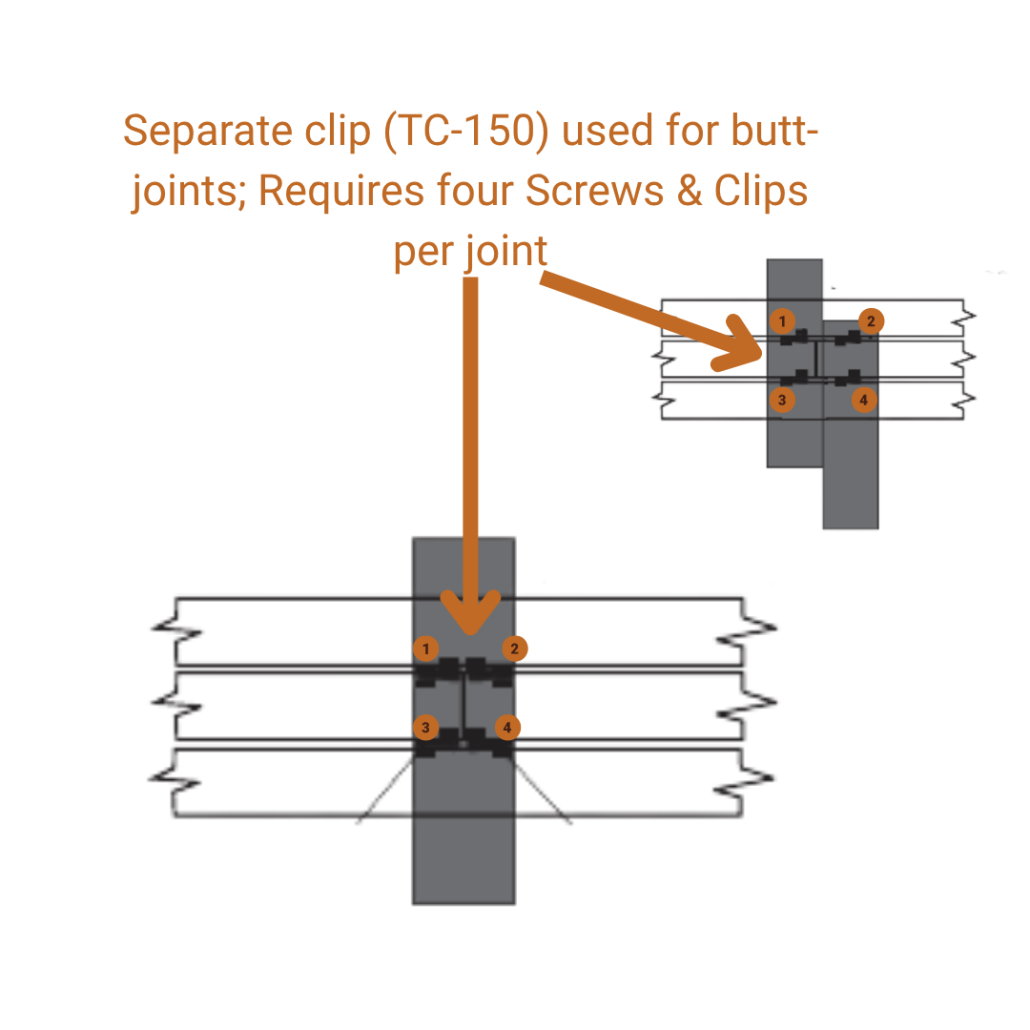
- Uses the TC-150 clip to handle butt joints on a single joist.
- This requires four clips and four screws per butt joint.
- That increases both labor time and material usage.
- No integrated trim fastening system is included.
- System Completeness: 8 / 10
For full product details, visit the manufacturer’s page: https://www.fastenmaster.com/products/tiger-claw-tc-g-hidden-fastening-clip
- Spring-based clip design instead of a wide bearing surface.
- Limited wingspan for handling hardwood expansion and contraction.
- Board replacement is more difficult due to inaccessible fasteners.
- Clips can bend under pressure, leading to inconsistent spacing.
- Butt joints require four screws, increasing labor and complexity.
- Overall design is better suited for composite decking than dense hardwood applications.
Disclaimer: All product names, trademarks, and brands are the property of their respective owners and are used for identification purposes only. This comparison is based on general product design characteristics and publicly available information at the time of writing. No affiliation or endorsement is implied. Performance may vary depending on installation methods, materials, and site conditions. For complete specifications and installation instructions, please refer to the manufacturer’s official documentation.
Black Talon Deck Clips
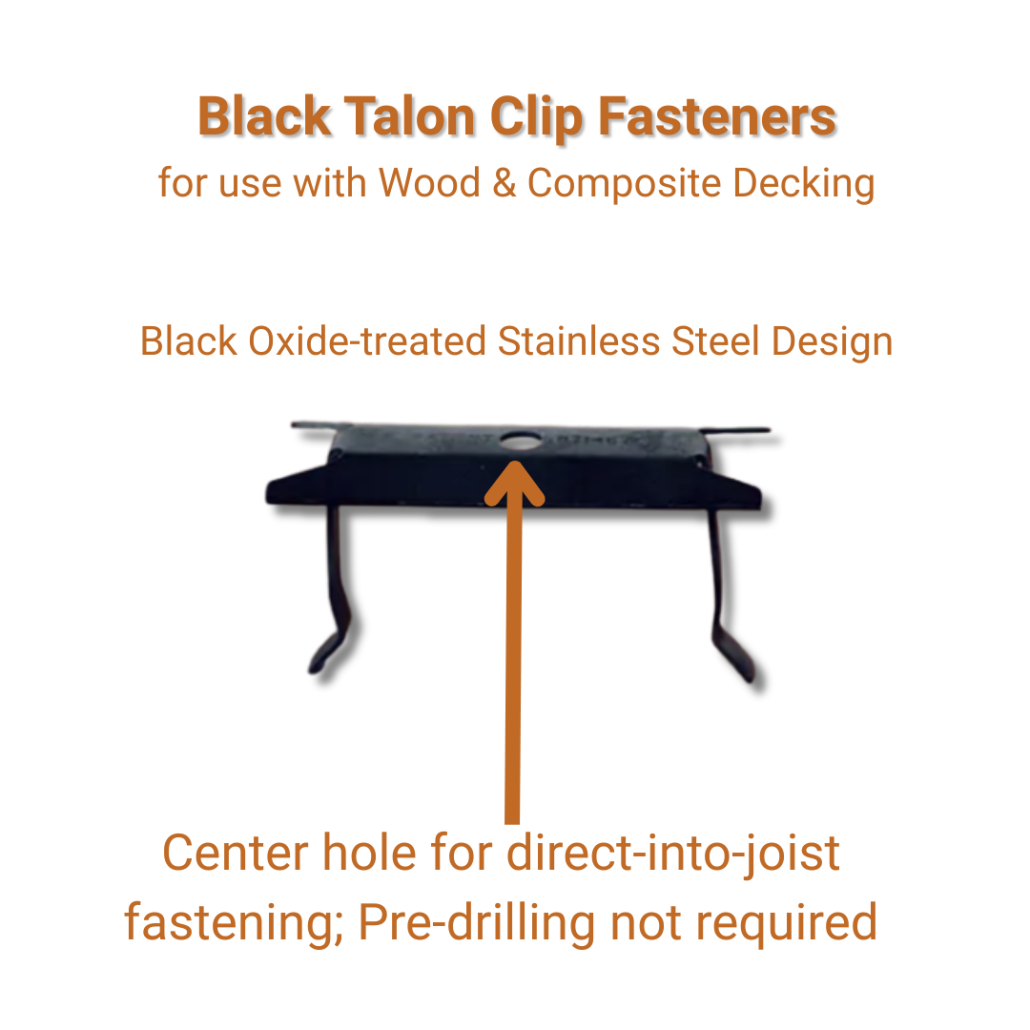
The Black Talon hidden deck clip system is a stainless steel fastening system designed for grooved decking. It uses a straight-down fastening method and a spring-style clip design to hold boards in place while allowing for movement. Positioned as a universal solution for both wood and composite decking, it emphasizes ease of installation and serviceability, though there are tradeoffs when applied to dense hardwoods.
- No pre-drilling required for most installations.
- Straight-down fastening makes installation more intuitive than angled systems.
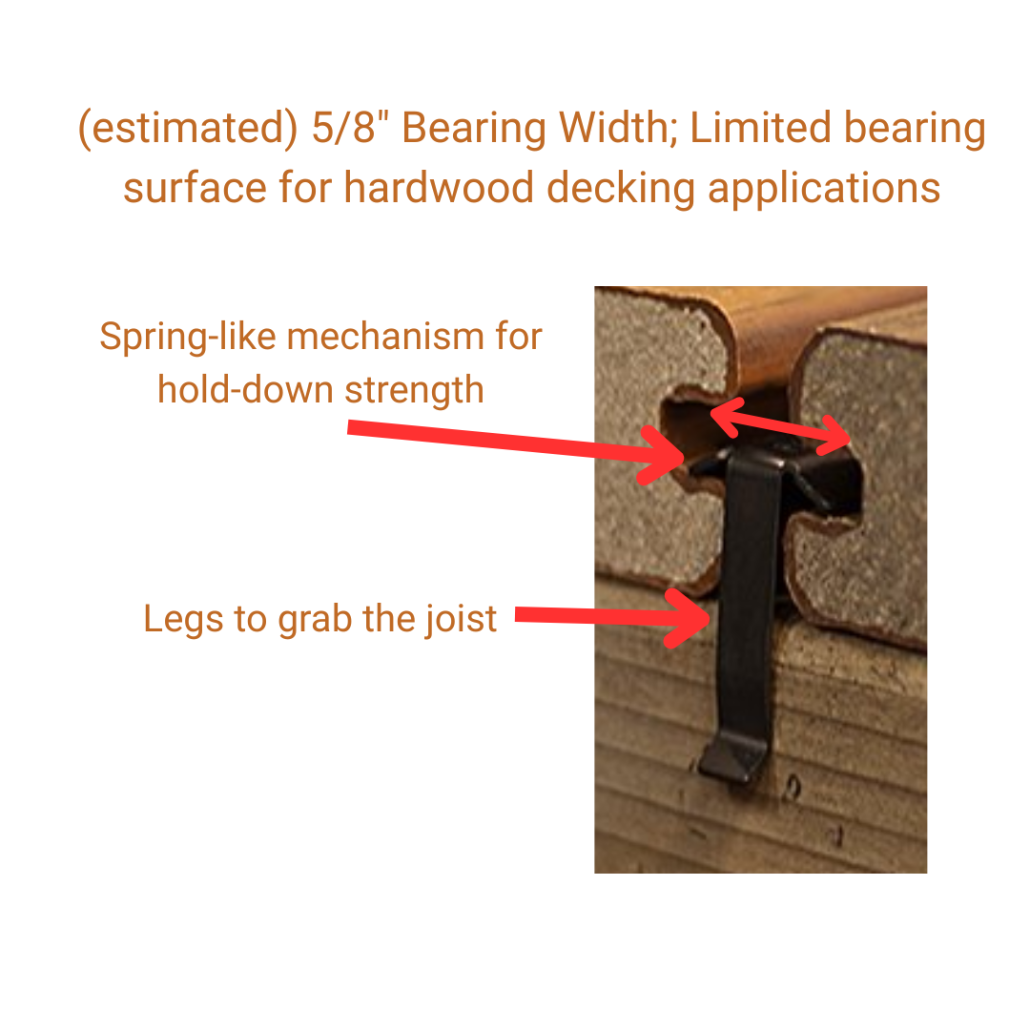
- Clips use formed “legs” to help position and hold the clip on the joist during install.
- Overall installation is straightforward and efficient for both contractors and DIY users.
- Ease of Use: 9 / 10
- Screws remain accessible after installation, which is uncommon for hidden fastener systems.
- Boards can be replaced by loosening adjacent clips, sliding the board out, and installing a new one.
- This greatly simplifies maintenance compared to systems with fully concealed fasteners.
- Board Replacement: 9 / 10
- Uses a spring steel mechanism to maintain tension and adapt to board movement.
- The clip is designed to flex with seasonal expansion and return to position over time.
- However, the effective bearing surface appears relatively narrow (~5/8″).
- Hold-down relies more on spring tension than broad surface contact.
- This may be less ideal for dense hardwoods, where wider bearing surfaces typically perform better.
- Hold-Down Performance: 6 / 10
- The spring-steel design introduces flexibility, which helps accommodate movement.
- However, this reduces rigidity during installation compared to solid clip systems.
- When using board straightening tools, pressure is concentrated on small contact points.
- This can lead to minor clip deformation or marking on hardwood edges.
- Installation Margin for Error: 6 / 10
- Includes a standard clip with joist-gripping legs and alternate clip options for non-standard joists.
- However, there is no clearly integrated butt-joint solution.
- There is also no dedicated trim or perimeter fastening system.
- Additional methods are required for more complex deck layouts.
- System Completeness: 7 / 10
For full product details, visit the manufacturer’s page: https://blacktalonuniversal.com/
- Straight-down fastening simplifies installation.
- Spring steel design allows movement and maintains tension over time.
- Accessible screws make board replacement easier than most hidden systems.
- Bearing surface appears limited compared to wider clip designs.
- Hold-down relies on spring tension rather than surface area.
- Folded metal contact points may concentrate pressure during board straightening.
- A versatile system overall, but not fully optimized for dense hardwood performance.
Disclaimer: All product names, trademarks, and brands are the property of their respective owners and are used for identification purposes only. This comparison is based on general product design characteristics and publicly available information at the time of writing. No affiliation or endorsement is implied. Performance may vary depending on installation methods, materials, and site conditions. For complete specifications and installation instructions, please refer to the manufacturer’s official documentation.
Final Takeaways
Hidden deck fasteners have come a long way, but one thing becomes clear when these systems are compared side by side: not all clips are designed for hardwood decking.
Many of the most popular systems on the market today were originally developed for composite or general-purpose decking. While they may perform well in those applications, hardwood introduces a very different set of demands—especially when it comes to seasonal movement, holding power, serviceability, and maintaining consistent board spacing over time.
- Seasonal expansion and contraction
- Higher density and greater holding demands
- Long-term serviceability and repair access
- Consistency of board spacing over time
- Plastic or hybrid clip designs often prioritize flexibility and ease of installation, but may sacrifice long-term hold-down performance.
- Narrow bearing surfaces can lead to board movement, inconsistent spacing, and greater risk of disengagement over time.
- Inaccessible fasteners make board replacement harder and often require destructive or time-consuming repair methods.
- Spring-tension designs rely on pressure rather than true mechanical hold-down.
- Incomplete systems leave installers to solve trim and transitions on their own.
- Wider and more consistent bearing surface
- Rigid spacing control
- Accessible fasteners
- Adhesive compatibility
- Complete fastening approach including trim and perimeter
For homeowners, contractors, and designers working with premium materials like Ipe decking, these differences can have a meaningful impact on both the installation experience and the long-term performance of the deck.
- Not all hidden fasteners are designed for hardwood.
- Clip bearing width matters.
- Butt joints are a critical detail.
- Adhesive compatibility improves performance.
- Fastener accessibility matters long-term.
- Plastic and spring systems have limitations.
- A complete fastening system leads to better results.
Ultimately, choosing the right fastening system is about more than just hiding screws—it is about building a deck that performs consistently, looks clean, and can be maintained over time.
If you’re planning a hardwood deck and want to explore fastening options in more detail, you can visit our deck fasteners page or review our BWD Clip installation guide.


